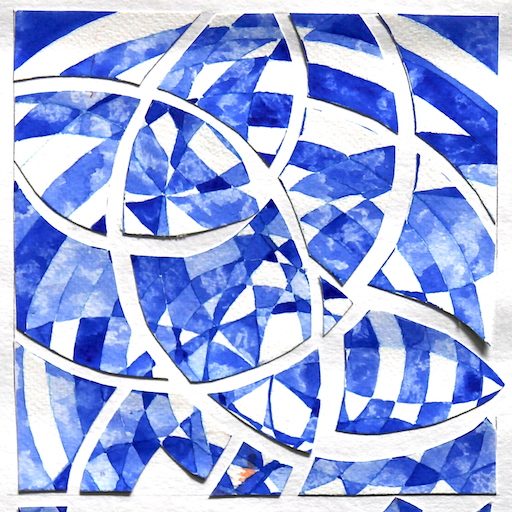
The edge keeps moving.
I would place it — between myself and a partner, a parent, a circle, a society I was trying to belong to — and find it had already shifted. Too much given. Too little held. The colour had moved before I finished the stroke.
I started painting. Not to understand. Because something needed a surface that wasn’t language.
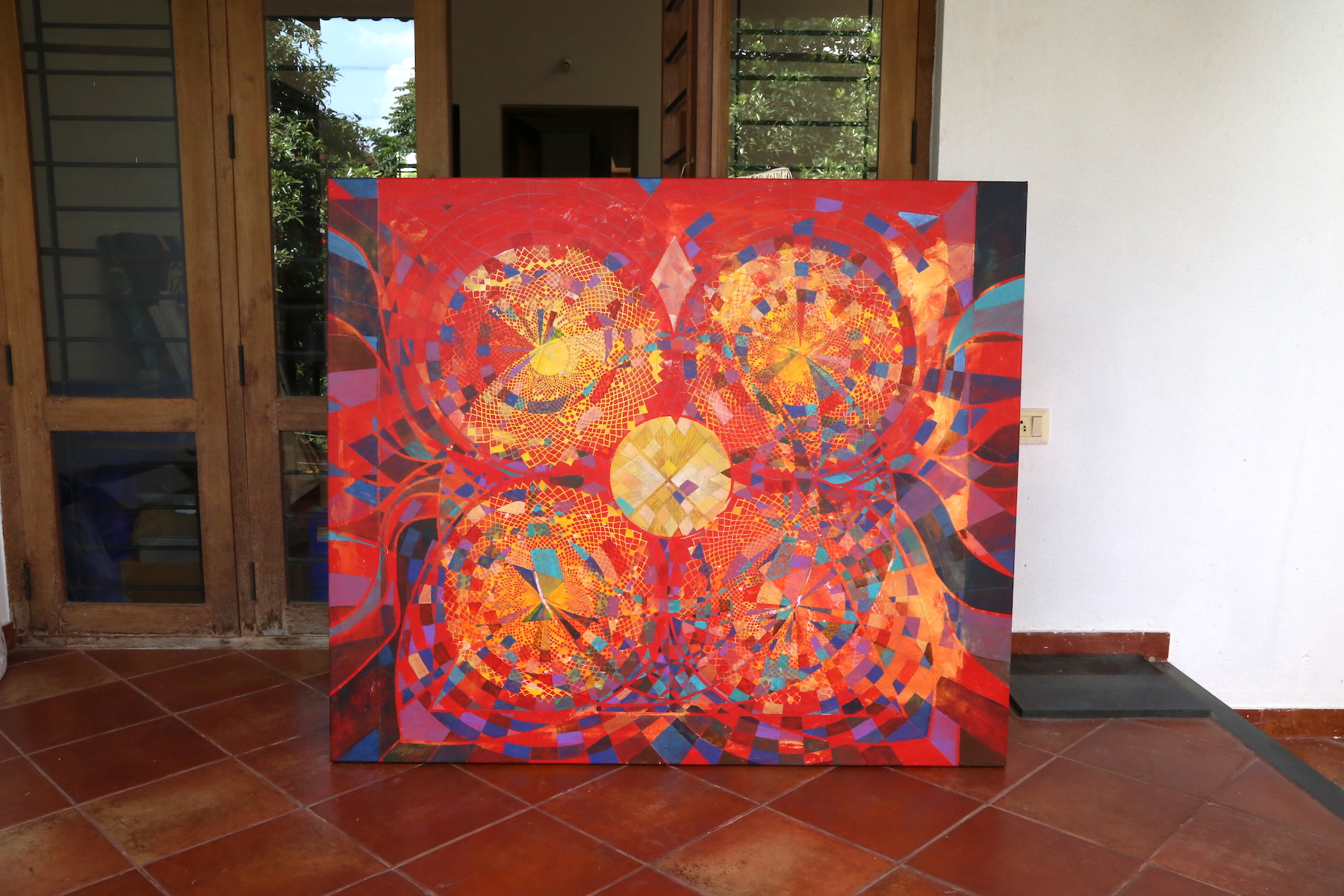
Three years of Art. Smaller watercolours, larger canvases, contemplating the small and the cosmic scale — Brahma’s day spanning 4.32 billion human years held alongside a single human morning. The self was constructed, permeable, perhaps not quite real. Ancient Indian philosophy had been alluding to it. I sought it.
—
Found something to press back.
I started AI conversations. Cold starts, no memory carried forward, a discipline around not accepting an answer just because it arrived well-dressed. I watched what distortions emerged. I watched what I brought and what came back. A fast tracked experiment.
What came back as responses were not what I had originally expected. The pressing back strangely took the shape of the pressure I applied. The entity had no edge of its own. Just mine, returned.
—
Two forms, overlapping. One obvious, immediately visible. One fainter — only there if you squint and look elsewhere. Both independent. Both held by something invisible.
I had seen this before. In a dream, in 2012. I didn’t know then what I was seeing – I broke the dream. I’m not certain I know now what I was seeing.
More to follow.
—
Ref:
Sneha Lakshman is a designer, artist, and philosopher.
This introduces an ongoing inquiry into human-AI interaction.
The full paper — The Shape of the Not-Knowing — to follow.
Leave a Reply